What happens to a productive market when banks retreat from it? The obvious answer is that credit becomes scarcer, although there is a second consequence which receives far less attention. Over time, the market itself can become increasingly invisible to international capital.
We have seen evidence of this recently in two very different commodity markets. In one, an established agricultural market, it is struggling to access the capital required to maintain and rebuild production. The underlying demand has not disappeared. There are productive assets, farmers, established export channels and international buyers. What has deteriorated is the financing infrastructure connecting those activities with capital.
We heard a remarkably similar observation in critical minerals. As international banks have reduced exposure to parts of the sector, specialist coverage and research have retreated with them. Smaller mining companies and projects can consequently become difficult for international investors to discover, understand and ultimately finance.
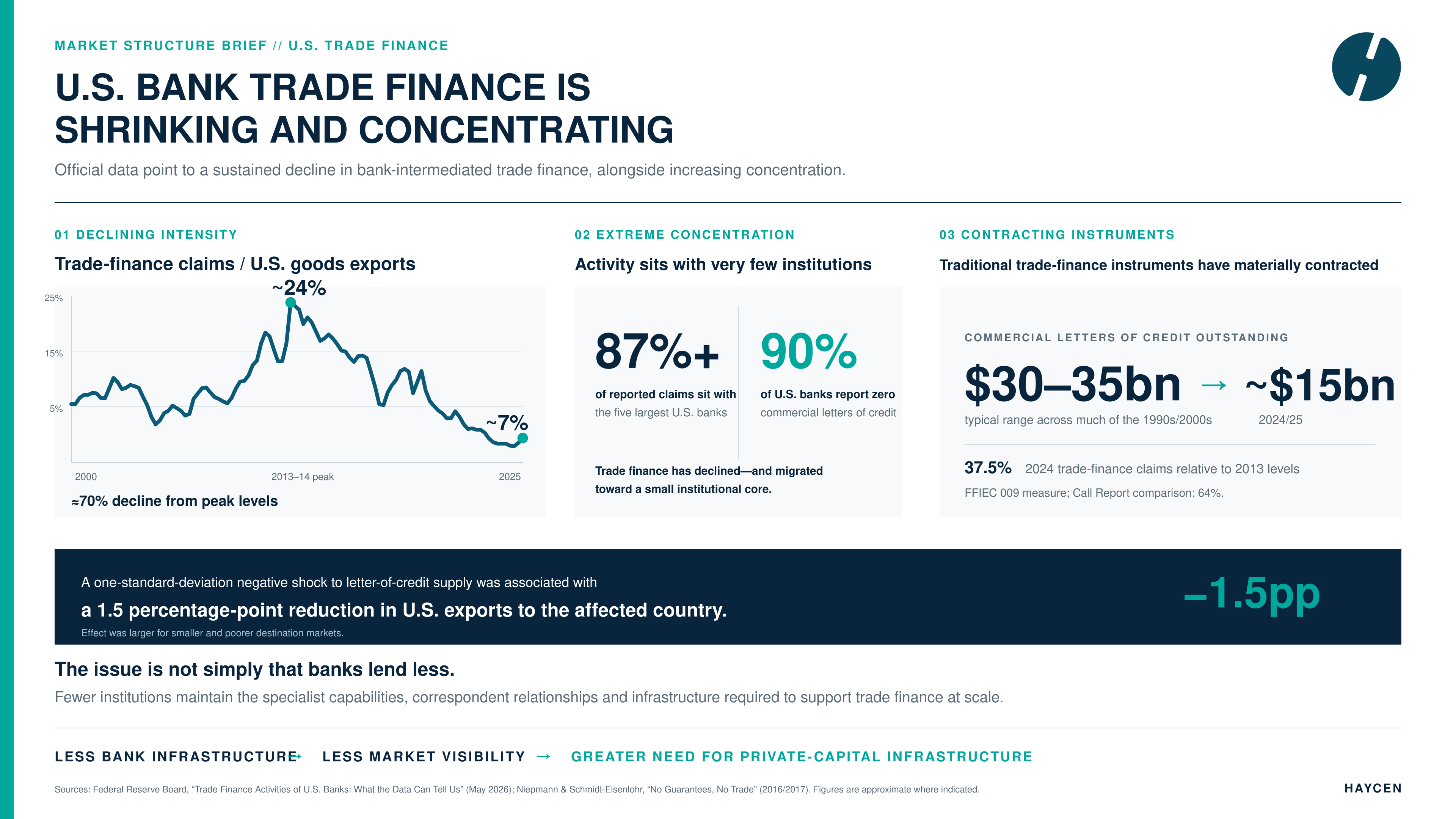
The Federal Reserve’s latest data on U.S. trade finance provides some context for what is happening.
Trade-finance claims relative to U.S. goods exports have fallen substantially since their 2013–14 peak. More than 87% of reported claims now sit with the five largest U.S. banks, while approximately 90% of U.S. banks report no commercial letters of credit at all. Outstanding commercial letters of credit were approximately $15 billion at the end of 2024.
The consequences extend beyond the banks themselves. Federal Reserve research has previously found that a one-standard-deviation negative shock to the supply of letters of credit reduced U.S. exports to the affected country by 1.5 percentage points. The effect was greater for smaller and poorer destination markets.
This points to a bigger market-structure issue. Banks have historically provided much more than balance sheet. They provided relationships, specialist expertise, research, underwriting capability, correspondent networks and an institutional bridge between local economic activity and global pools of capital. When those capabilities retreat, replacing the lending capacity alone does not necessarily solve the problem.
Simply put, private capital cannot replace bank balance sheets if it cannot see what the banks used to see. That is particularly striking because some of the markets affected are becoming more economically important, not less. Critical minerals sit at the centre of enormous investment requirements across energy, technology and industrial policy. Agricultural commodities remain fundamental to economies across the emerging world.
Economic importance, however, does not automatically create institutional capital access. There is substantial private capital globally seeking productive deployment. The challenge is increasingly how that capital discovers opportunities, evaluates them and then operates in markets historically intermediated by banks.
That requires a different type of infrastructure. Investors need to know who they are dealing with, what they are financing, which assets and cash flows sit underneath a programme and how capital will move. They need reliable programme data, appropriate governance and visibility after deployment. They also need infrastructure through which capital can be deployed, monitored, settled and ultimately recycled.
Digital capital infrastructure, including regulated stablecoin and tokenised deposit rails where appropriate, can play an important role here. Not because digitising money solves the underlying credit problem, but because these rails can sit within a broader institutional architecture that gives investors greater control and visibility over how capital is deployed and returned.
The objective should not be to recreate the bank. Nor should infrastructure providers assume the underwriting and investment decisions that properly belong to specialist lenders and investors. The opportunity is to recreate the institutional connectivity that allowed capital to reach these markets in the first place.
And that distinction matters because a productive market does not become unproductive when banks retreat from it. Without the infrastructure connecting it to international investors, however, it can become much harder for capital to see.
In conclusion, the next generation of private-market infrastructure should make those markets visible again.