Global trade is financed through a remarkably diverse collection of credit models. At one end are technology-enabled working-capital lenders providing relatively small, short-duration facilities to businesses that have historically struggled to access bank financing. At the other are specialist credit managers financing larger, more complex trading relationships involving commodities, inventory, receivables and recurring open-account credit. Between them sit invoice financiers, purchase-order lenders, supply-chain finance platforms and structured trade-credit providers.
These businesses are frequently grouped together under the broad heading of trade finance. Yet they underwrite different risks, serve different borrowers and operate with fundamentally different economics. Their common characteristic however is not the type of credit they provide but their dependence on capital to finance the credit they originate.
Over the past decade, technology has made meaningful progress in reducing the cost of originating, underwriting and servicing these assets. But a fundamental question remains: if technology is making trade credit easier to underwrite, why does financing it remain so complex and fragmented? The answer lies in the distinction between improving the economics of underwriting and improving the economics of capital.
1. Pick your credit model
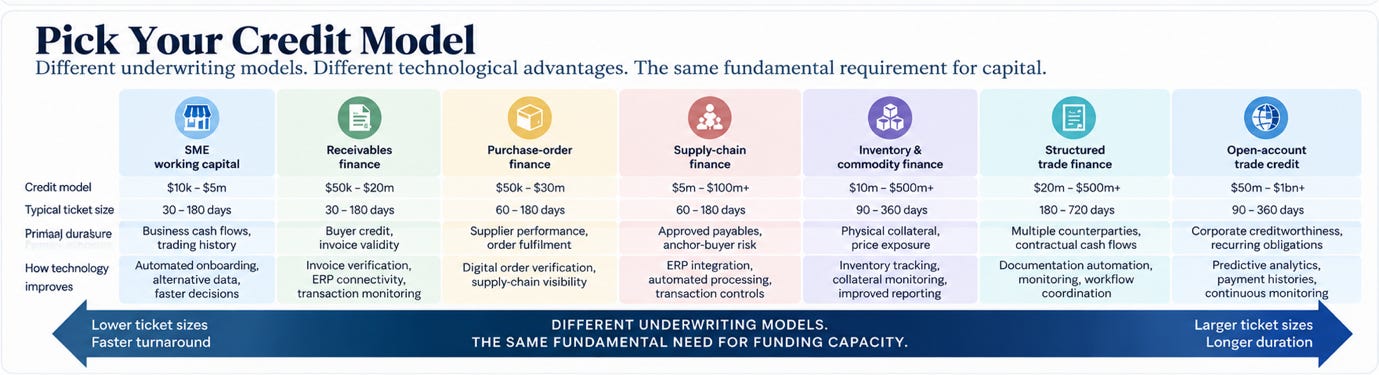
Consider the range of underwriting models operating across global trade.
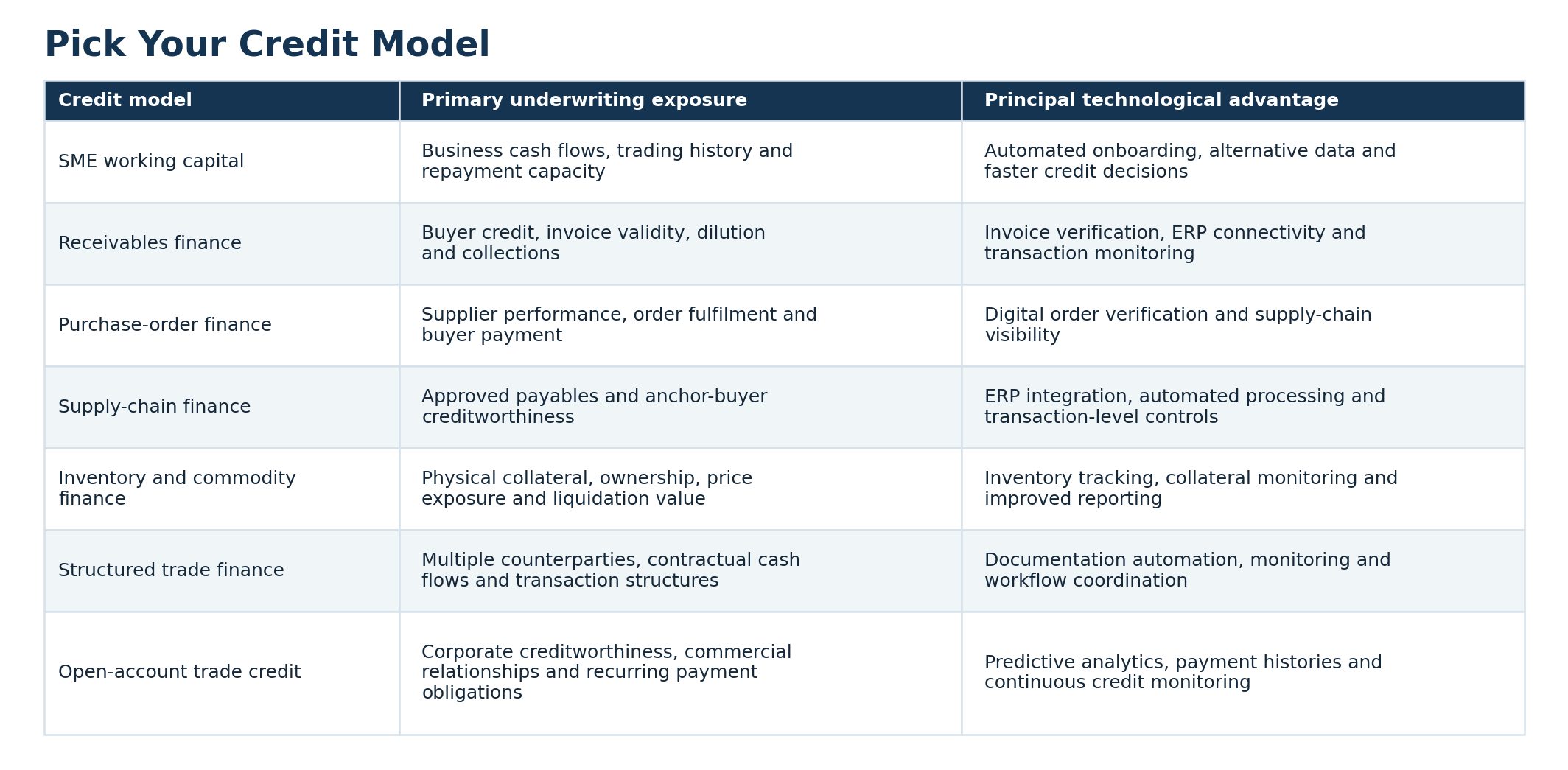
These categories overlap. A lender may use several underwriting approaches within the same facility, and transaction sizes vary substantially within each model.
Nevertheless, they illustrate how technology can affect the economics of credit in different ways. A working-capital lender might use transaction data to automate smaller credit decisions, receivables financier might use ERP connectivity to verify invoices and monitor collections, a commodity lender might use digital collateral records and inventory monitoring to reduce operational risk and a structured-credit manager might automate documentation and reporting across multiple counterparties. Each technological improvement has value but none eliminates the need to fund the underlying exposure.
2. The Capital Delta
Technology and vertical specialisation can reduce the cost and time of borrower acquisition, underwriting, servicing and monitoring, allowing lenders to process more transactions and serve borrowers poorly accommodated by traditional infrastructure.
An origination business can scale computationally, but the lending book must scale financially. Greater underwriting capacity does not create the capital required to fund additional loans. A specialist lender may therefore identify more attractive credit than it can finance, widening the gap between origination capacity and deployable funding.
Technology can improve the economics of underwriting credit, but it cannot independently improve the economics of funding it. An origination business can scale computationally, a lending book has to scale financially. And that remains a big disconnect, as underwriting becomes efficient, the distance between financeable opportunities and available capital can actually widen.
The Capital Delta: Technology-enabled origination versus available funding.
The widening gap between financeable opportunities and available funding is not merely a theoretical concern. Research by the IFC and SME Finance Forum found that, between 2015 and 2019, potential demand for MSME credit in emerging markets grew by approximately $2.2 trillion, while credit supply increased by just $991 billion. The estimated financing gap widened by 27%, reaching $5.7 trillion.
The figures cover MSME financing broadly rather than trade credit specifically, but they illustrate an important structural dynamic: funding can expand substantially without keeping pace with the opportunities requiring it.
The pattern is consistent with the persistence of unmet demand in global trade. The Asian Development Bank estimates that the trade-finance gap remained at $2.5 trillion in 2025, despite continued investment in digitisation, automation and financial infrastructure.
The question is therefore not simply whether technology can make more credit opportunities economically viable. It is whether the capital required to finance those opportunities can be mobilised and deployed at a comparable rate.
Illustrative figures only. Financeable opportunities are assumed to satisfy the lender’s underwriting criteria. The table compares a pipeline of opportunities with the capital available to fund them over a comparable period; it does not represent an industry estimate.
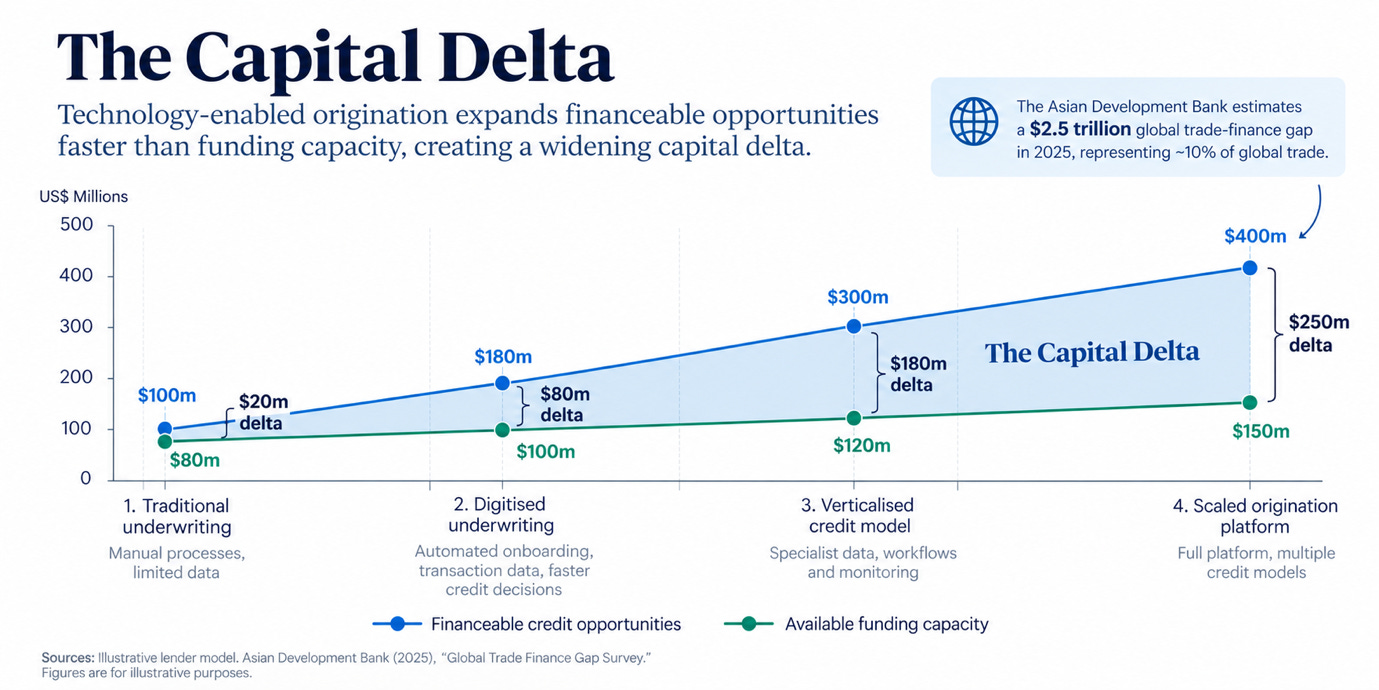
Technology has expanded the lender’s underwriting capacity and financeable customer base, but funding has not kept pace: the capital delta has widened because technology can increase the supply of financeable credit opportunities faster than the financial system increases the capital available to fund them.
This constraint is especially relevant to non-bank and specialist lenders, which rely on external capital subject to investor mandates, concentration limits and operational requirements. However specialised the underwriting model, the capital supporting it must still be sourced, structured and allocated.
3. Better underwriting doesn’t necessarily mean more capital
Capital scarcity is not always the binding constraint in credit markets. Some opportunities are unattractive because the underlying risks are too high, whilst others are constrained by weak documentation, uncertain enforceability, inadequate collateral or insufficient information. In these circumstances, the absence of financing may be a rational outcome. Better technology can certainly help. Improved information can reduce uncertainty. More effective monitoring can reduce operational risk. Standardised documentation can improve transparency. And stronger underwriting can help investors distinguish between attractive and unattractive exposures. These improvements may increase the amount of capital willing to participate in a particular credit market but the relationship is not automatic and reducing the cost of understanding risk is not the same as reducing the risk itself.
Nor does it eliminate the separate processes through which institutional capital is allocated. A credit opportunity can be well underwritten, commercially attractive and operationally efficient without fitting an investor’s mandate. This is why the development of increasingly sophisticated credit models does not necessarily resolve the capital constraint. The challenge is not simply to originate better credit, it is to connect that credit with capital capable of financing it, on terms that work for both parties.
4. The overlooked economics of capital efficiency
If capital availability is one constraint, capital efficiency is another. These are related but distinct problems. Capital availability determines how much financing capacity a lender can access. Capital efficiency determines how productively that financing capacity can be used. Consider two lenders with identical funding capacity. Both have $100 million available for deployment. Both finance trade-credit assets with an average duration of 90 days. Both have sufficient eligible opportunities to keep their capital deployed. The difference lies in what happens when an asset matures. Lender A requires an additional 15 days to reconcile repayment, release capital and deploy it into the next transaction. Lender B completes the same process in two days. The underlying credit duration is unchanged. The amount of capital is unchanged. But the productive capacity of that capital is different.

Illustrative annualised calculations assuming continuous eligible demand, full deployment when available, no defaults and no additional liquidity constraints.
Lender B supports approximately 14% more annual financing throughput using the same $100 million of capital. It has not raised more money. It has not shortened the underlying credit exposure. It has simply reduced the period during which capital is unavailable for productive deployment. The relationship can be expressed through a simple equation:
The capital-efficiency equation
Annual financing throughput ≈ Available capital × 365 × Utilisation ÷ Average capital cycle (days)
The equation separates three variables that are often discussed together but have different economic effects.
1. Available capital: The amount of funding accessible to the lender.
2. Utilisation: The proportion of that capital productively deployed.
3. Capital velocity: The frequency with which capital can complete one financing cycle and become available for another.
Underwriting technology can improve the quality and efficiency of selecting credit opportunities. It may also improve utilisation by increasing the availability of suitable transactions. But the efficiency of the capital cycle depends on additional factors: repayment, reconciliation, settlement, liquidity management and redeployment. These activities are often treated as operational considerations. Economically, they determine how much financing activity a fixed pool of capital can support over time. That makes capital efficiency a strategic variable, not merely an administrative one.
5. The next frontier in trade-credit innovation
The evolution of credit underwriting in global trade is a genuine technological success: businesses can be assessed more quickly, transactions monitored more effectively and specialist lenders operated with greater precision and lower administrative costs.
Much of the technological development in trade finance has focused on improving the lender: digitising documentation, automating underwriting, improving data, monitoring collateral, reducing servicing costs and developing deeper expertise within particular credit verticals.
These improvements are valuable and will continue, but they principally address how credit opportunities are identified, assessed and managed. They do not, by themselves, solve how capital moves towards those opportunities. Institutional investors must still discover suitable credit strategies, assess the relevant lenders and structures, allocate capital within their investment mandates and establish the arrangements required to deploy funds. Once transactions mature, that capital must also be reconciled and made available for further deployment. Each step introduces time, cost and coordination. For a specialist lender, these frictions can be just as consequential as the cost of underwriting the underlying credit; for an institutional investor, they can determine whether an otherwise attractive credit strategy is operationally accessible.
This suggests that the next phase of innovation in global trade credit may require a different unit of analysis: not simply the loan, the borrower or the underwriting model, but the capital cycle itself. How efficiently can institutional capital identify suitable credit opportunities, how easily can it be deployed across different specialist strategies, how transparently can exposures be monitored, how quickly can repayments be reconciled, and how effectively can capital be recycled into the next opportunity? These questions apply across the credit-model continuum. They matter to technology-enabled working-capital lenders, receivables financiers, commodity lenders, structured-credit managers and institutions financing larger, recurring open-account trade relationships. The underwriting models differ, but the challenge of accessing and efficiently deploying capital remains.