For the past decade, the stablecoin industry has evolved remarkably quickly, with billions of dollars now moving every day across digital rails. Settlement is faster, liquidity is deeper and institutions are increasingly engaging.
The industry has evolved through two distinct stages.
Stage One: “Own the stablecoin. Own the economics.”
The first generation focused on issuance. Success depended on distributing as many tokens as possible and capturing the economics of transaction activity.The assumption was straightforward that if you control the token you control the network.
Stage Two: “Keep your stablecoin. We’ll provide the infrastructure”
The second generation recognised that not every institution wanted someone else’s token. Stablecoin infrastructure platforms emerged, allowing banks, enterprises and fintechs to issue their own digital dollars while outsourcing the technology.Control shifted from issuance towards software but fundamentally, the question remained the same which was “How do we move money more efficiently?”
Better mousetraps rarely create new markets.
Both generations have largely pursued the same objective of a “better” settlement rail or a “better” wallet or a “better blockchain”.
Simply, a “better” way of moving money.
In many respects, the industry has pursued the classic better mousetrap principle, assuming that improving the mechanics of settlement will naturally unlock widespread institutional adoption. But in our opinion this has not happened.
Institutions rarely struggle because settlement is difficult. Settlement is increasingly becoming a solved problem. The larger constraint lies somewhere else.
The missing question
Throughout the development of innovation cycles, every technological wave eventually reaches the same conclusion, which is that technology alone stops being the differentiator.
In B2B, markets begin asking “What new institutions become possible now this technology exists?”
History will back this view up. Electronic trading didn’t simply digitise paper tickets, because it created exchanges, clearing houses and entirely new market structures.
Similarly, the internet didn’t just make communication faster; it created platforms, marketplaces and operating models that were previously impossible.
In our opinion, stablecoins are approaching the same inflection point.
Rather than asking how do we replicate today’s financial system but instead move digital dollars, perhaps the better question is:
What new institutional structures now become possible once value itself becomes programmable?
Settlement therefore isn’t the bottleneck over time. It’s further upstream because before money moves, someone has to create it. Not mint it like a stablecoin, but form it, discover it, verify it, govern it, structure it and deploy it. Only then does settlement matter.
This is also where market structure starts to change. As markets mature, there comes a point where the cost of repeatedly coordinating between independent institutions exceeds the competitive advantage of keeping every interaction proprietary. Infrastructure then begins to emerge, not to replace competition, but to remove the coordination burden around it. Participants continue to compete on judgement, pricing, risk and relationships, while increasingly sharing the infrastructure required for identity, governance, interoperability and settlement.
The competitive advantage remains proprietary. The coordination becomes shared. Participants compete on judgement. They cooperate on coordination.
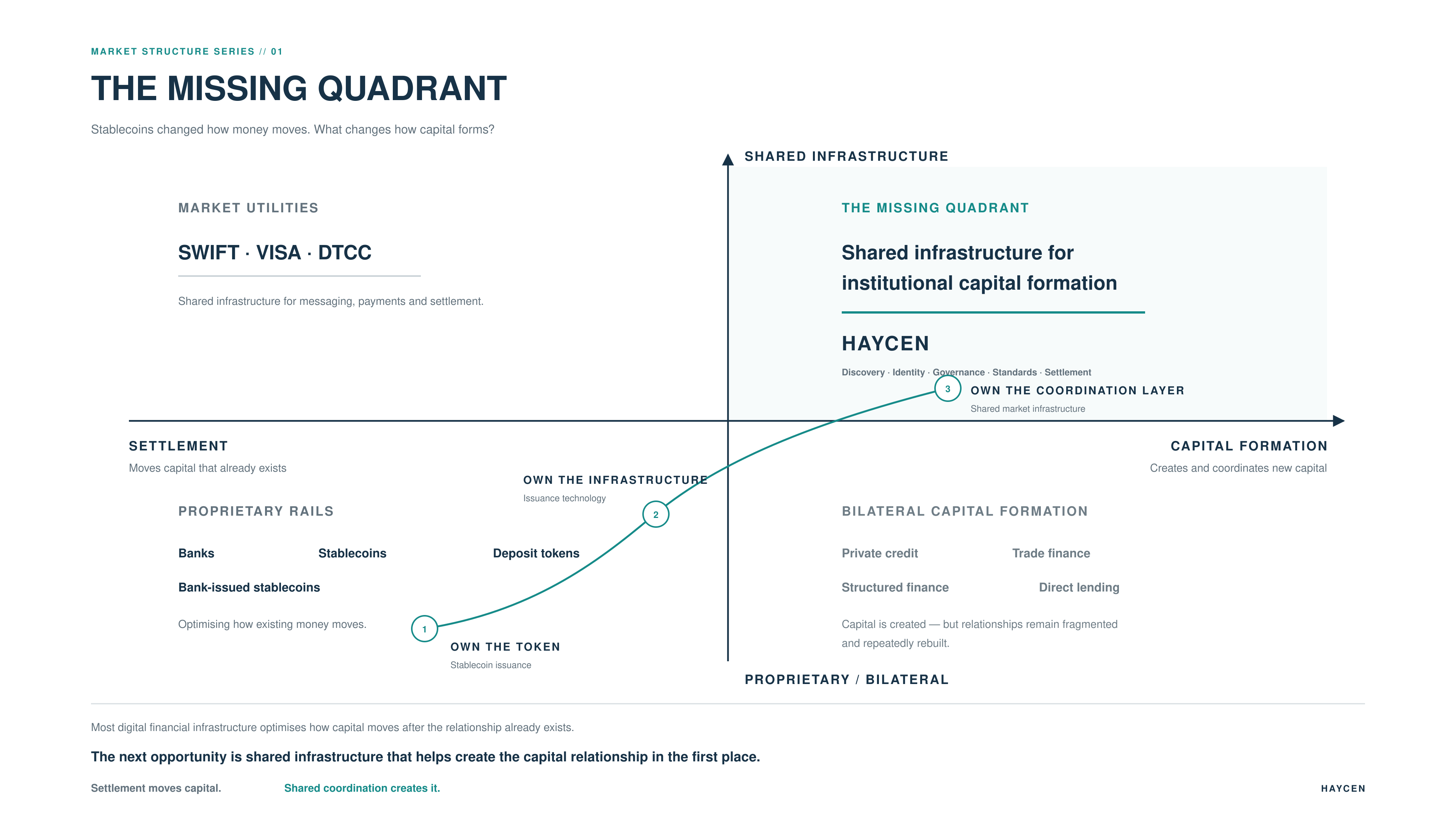
This picture is revealing.
Traditional banks, stablecoins and even bank-issued deposit tokens are primarily concerned with moving existing capital more efficiently.
Market utilities such as SWIFT and Visa coordinate that movement across participants but almost nobody is building infrastructure dedicated to forming and coordinating new institutional capital itself.
That is the missing quadrant because it solves the upstream problem. Most stablecoin businesses compete for downstream economics eg settlement, transaction fees, wallets, distribution.
But those economics only exist because capital has already been created upstream.
The greater opportunity may therefore lie not in optimising settlement but in reducing the cost of forming and coordinating institutional capital programmes in the first place.
Solve the upstream problem of forming and coordinating institutional capital, and the downstream settlement economics become a consequence rather than the business model itself.
The economics don’t disappear, they instead become more durable because they originate from solving the larger market problem.
A third generation of market infrastructure
So, the first generation asked who owns the stablecoin? The second asked who owns the infrastructure? The next generation may ask something far more fundamental.
The economic model changes with too. The first generation created value through issuance. The second created value through technology. The third creates value through interaction. As more capital providers, originators and institutions participate through shared infrastructure, the value of the network increasingly derives from the relationships, programmes and capital activity it enables.
The missing quadrant isn’t another blockchain or another stablecoin or another wallet.
It’s the institutional infrastructure that allows fragmented markets to form, coordinate and discover institutional capital before settlement ever begins.