Every successful infrastructure company organizes one recurring economic interaction.
Visa organizes payment acceptance. SWIFT organizes financial messaging. DTCC organizes ownership transfer.CLS organizes settlement finality. AWS organizes access to compute.
Infrastructure doesn’t emerge because of a new technology innovation cycle. It emerges because markets repeatedly coordinate the same interaction until standardization becomes more valuable than duplication.
The core question is never, what technology do they use?. It’s always, What recurring interaction have they standardized?
Now zoom into global trade, a market we’ve now lived in for several years. It’s a market supporting trillions of dollars of institutional capital each year but has remained remarkably fragmented. Thousands of lenders, investors, commodity traders and financial institutions participate, yet each independently forms, governs and maintains its own capital relationships.
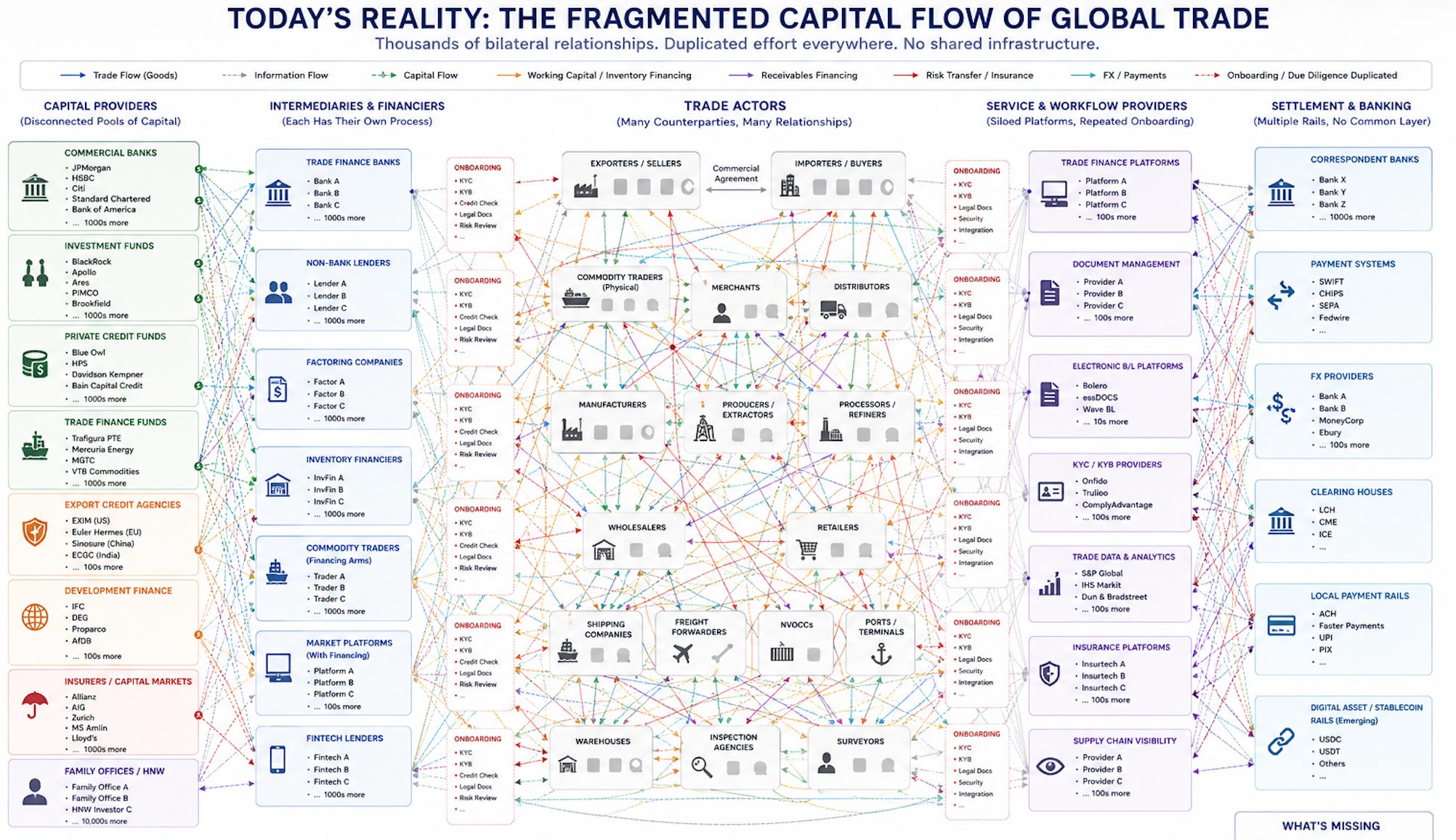
You probably think this is a map of global trade but actually it’s a case study in how institutional capital is organized. Every coloured line represents relationships formed independently.Every onboarding process represents governance recreated from scratch.
Every institution has built its own way of coordinating capital. Very little of that coordination capability is shared, despite it not being completely proprietary. Global trade simply makes this visible.
The Wrong Unit of Analysis
This also explains why so many fintech products struggle to capture market share and / or become a globally relevant operating layer in this market.
Trade looks like a payments problem because payments are the only thing most people can observe.
As a result, much of today’s innovation focuses on making payments, FX, settlement and treasury more efficient. These are all valuable capabilities.
But they’re analysing the wrong unit; the unit of analysis isn’t the payment it’s the formation of the institutional capital relationship that makes the payment possible.
Before a payment can move, institutions must discover one another, establish trust, complete governance, negotiate participation and commit capital. Only then does a payment occur.
Payments therefore aren’t the problem.They’re the visible consequence of solving the problem.
In an era where digital infrastructure is rapidly emerging, perhaps our objective shouldn’t be to recreate an increasingly fragmented financial ecosystem in digital form.
Perhaps we should ask a more fundamental question.
If we’re rebuilding financial infrastructure for the digital age, should we simply replicate the fragmentation of the existing system—or should we solve the coordination problem that created it in the first place.